Tire Science & Pressure Optimization
Your tires are your only contact with the terrain, and mastering their use is critical.
Lowering tire pressure increases the contact patch, improving traction in loose surfaces. For example, dropping from 35 PSI to 12 PSI can increase the footprint by 25–30%, allowing the tire to “wrap” around rocks for better grip.
But this also reduces bead retention, which is where beadlock wheels become invaluable in extreme terrain.
When running beadlocks, follow manufacturer torque specs — usually in the 12–18 ft-lb range — to avoid warping the bead ring. Over-torquing can cause uneven sealing and potential failure.
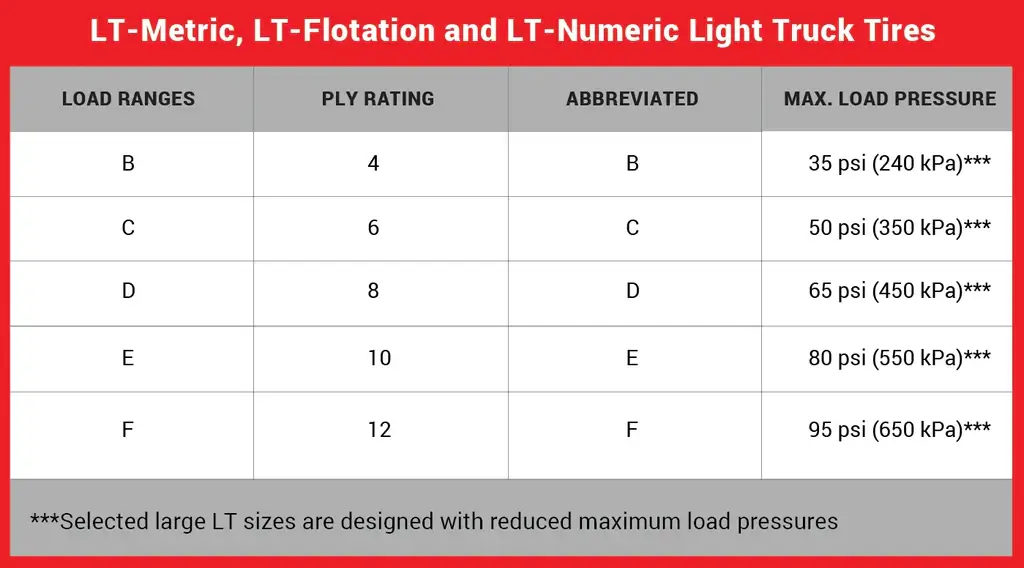
Tire Load and Ply
Sidewall construction also matters. Load Range C tires flex more than Load Range E, which can be beneficial off-road but less durable under heavy loads. Understanding ply construction and rubber compound is important for selecting a tire that matches your terrain.
An often-overlooked factor is heat buildup from long-distance aired-down driving. As flex generates heat, tires can delaminate or lose structural integrity. Reinflate before highway speeds to avoid blowouts.
Advanced Recovery Techniques
Recovery is where technical skill and safety awareness intersect.
Winching physics: A single-line pull uses the winch’s full drum speed but at lower pulling power. Adding a snatch block can double pulling power by halving line speed and spreading the load. However, every piece of gear must have a Safe Working Load Limit (WLL) greater than the maximum force generated.
Use the formula:
Required WLL = (Vehicle Weight × 1.5) ÷ Gear Ratio
For a 5,000 lb vehicle stuck in mud, that’s easily 7,500+ lbs of force, not counting suction resistance.
Kinetic recovery ropes
(like Bubba Ropes) can stretch up to 30%, converting stored energy into a smooth pull that reduces shock loads. Never use them with a winch or static anchor — the snap-back force is dangerous.
Always use damper blankets on recovery lines to reduce recoil risk if a line fails.
When setting up a proper off-road winching system, the process usually begins with establishing a solid anchor point, whether that’s a tree, a rock, or another vehicle. From there, incorporating a snatch block can greatly increase efficiency, as it allows you to change the direction of the pull or even double the pulling power of your winch. This setup directly affects the line pull, reducing the strain on your winch and cable while improving overall control. By distributing and managing tension correctly, you create a safer and more effective recovery, protecting both your equipment and everyone involved in the process.
Navigation & Terrain Reading
Expert off-roaders navigate beyond trail maps — they read the land.
Topographic maps reveal elevation changes through contour lines. Closely spaced lines indicate steep slopes; wide spacing means gradual terrain. Learning to identify gullies, ridgelines, and saddles from a map allows for better route planning before even setting tire to dirt
GPS devices with elevation overlay allow you to plot waypoints factoring in vertical gain. For example, a trail that’s 4 miles with 1,200 feet of elevation gain may require gearing changes or fuel adjustments compared to flat terrain.
When crossing water, evaluate flow rate, depth, and substrate. Seasonal snowmelt or storms can turn a shallow crossing into a dangerous, axle-deep hazard. Look for eddies or debris lines to gauge water movement and depth.
3D Imagery
Satellite imagery is an advanced planning tool. Programs like Google Earth Pro let you check historical imagery for changes in riverbeds, trail erosion, or vegetation — indicators of shifting terrain.